.
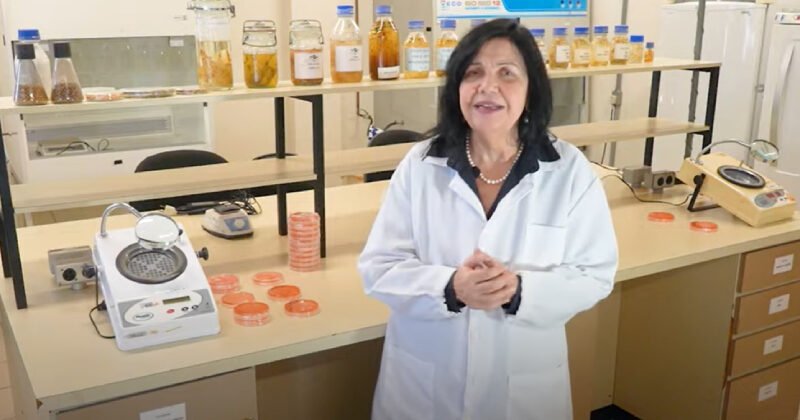
Agronomist Mariangela Hungria received the Luiz de Queiroz Medal on October 8. The honor was presented during a ceremony at USP’s “Luiz de Queiroz” College of Agriculture (Esalq), in Piracicaba, as part of the program for the 69th Luiz de Queiroz Week. Awarded by Esalq, the medal recognizes Brazilian and foreign figures for their merits and significant services to the State in activities related to the development of agriculture. The award is granted upon nomination by the Medal Council and approval by the State Council of Honors and Merit.
She is an Esalq alumna, having graduated in Agronomy in 1979 and completed her master’s degree in Soils and Plant Nutrition in 1981. Recognized for excellence in the scientific community, Mariangela received the World Food Prize in 2025. Given its prestige, the award is considered the Nobel Prize for Agriculture. The Luiz de Queiroz Medal award ceremony was held in Esalq’s Great Hall.
Career
Mariangela Hungria graduated in Agronomy from Esalq in 1979. She earned a master’s degree in Soils and Plant Nutrition from Esalq in 1981 and a doctorate in Agronomy (Soil Science) from the Federal Rural University of Rio de Janeiro (UFRRJ) in 1985. She completed postdoctoral research at Cornell University, in New York, United States, in 1989; at the University of California, Davis, United States, in 1991; and at the Universidad de Sevilla, in Seville, Spain, in 1998. She was a researcher at Embrapa Agrobiologia from 1982 to 1991 and has been a researcher at Embrapa Soja since 1991. She is a professor at the State University of Londrina (UEL), in the graduate programs in Microbiology and Biotechnology, and works in Agronomy, with an emphasis on Soil Biotechnology.
The researcher has more than 500 scientific articles, books, and book chapters, as well as 80 technical publications and 600 abstracts presented at conferences, meetings, and workshops. She has launched 25 technologies, including rhizobial strains for common bean, Azospirillum for maize, wheat, and brachiaria, and the co-inoculation of rhizobia and Azospirillum for soybean and common bean. She leads INCT MicroAgro and participates in international networks and projects. She is a researcher at the National Council for Scientific and Technological Development (CNPq) Level 1A, belongs to scientific academies in Brazil and abroad, and has received dozens of awards, including the 2025 World Food Prize. Mariangela also appears on lists of the world’s most influential scientists, including those published by Stanford, Research.com, and AD, as well as Forbes, the 2025 TIME100 Climate list, and the 2026 TIME100 Most Influential People list.
Medal
Designed by visual artist Archimedes Dutra, the Luiz de Queiroz Medal is a circular gold medal measuring 3.5 centimeters in diameter. It bears symbols representing teaching, research, extension, and the multiple fields of knowledge developed by Esalq, and is suspended from an emblematic ribbon in green, yellow, white, and reddish-brown. It was established by State Decree No. 11,035 of December 29, 1977, under the administration of Paulo Egydio Martins.
Written by Caio Albuquerque, from the Esalq Communications Division
English version: Nexus Traduções, edited by Denis Pacheco
Sobre o Autor